“history is a living weapon in yr hand”

I grew up in a relatively nondescript split-level suburban-New Jersey house on a literal dead end in a white ethnic family taking their first steps into the middle class. My father went to college on a baseball scholarship; my mother could not go. None of my grandparents attended school after the eighth grade.
I grew up in a relatively nondescript split-level house in a one-square mile commuter town because my parents were trying “to save us” from a city 20 miles north (where I and most of my family were born).
The riot (as the 1968 uprising was known in the predominantly white news media) sparked and flamed across Newark, NJ, for five July days. First local then state police and National Guardsman clashed with Black protestors with increasing violence. Buildings burned. The National Guard sent tanks down city streets; officers fired indiscriminately into apartment buildings. In the end, 26 people were killed: 24 of them Black.
I grew up on a literal dead-end street in a commuter town, because my parents were afraid of a newsreel, of headlines, of Black people.
My family’s racist reaction to the uprising hemmed and defined my life: from where I was raised to the kind of modest wealth white flight allowed my parents to garner, from the places I was allowed to go to the histories I would not be taught.
My situation was not unique. In her book, America on Fire: the Untold History of Police Violence and Black Rebellion Since the 1960s, historian Elizabeth Hinton explains: “From May 1968 to December 1972, some 960 segregated Black communities across the United States witnessed 1,949 separate uprisings.”
How many people have an uprising in their childhood? A protestor or a national guard unit in their head?
*

“history is a living weapon in yr hand,” writes the poet Diana DiPrima.
My family, like many if not most white families who lived in or near Newark at that time, were unharmed by the uprising. On the other hand, many Black families suffered devastating costs. Still, in the years following, Black leaders continued organizing, built coalitions, and oversaw the election of Newark’s first Black mayor in 1970. The poet and activist Amiri Baraka laid the groundwork for a utopian community known as New-Ark. The history, of course, is complicated. And yet, the current mayor of Newark is Ras Baraka, Amiri’s son. In part because of the elder Baraka’s work, since 1970, all of Newark’s mayors in what remains a majority Black city have also been Black.
I look to this past for models to meet the current moment: in stories of resistance covered over like bomb shelters, redacted from dominant histories like proper names from a CIA memo. . I look to this past because I know, as Civil Rights Activist Fannie Lou Hamer told a majority white audience in a 1971 speech, that “your freedom is shackled in chains to mine.” I look to this past because it provided me advantages at the expense of others, and I worry about debts that remain unpaid. Over the years of my continuing re-education, the Newark uprising became a flash point from which to begin my studies on a variety of struggles for liberation and reparations. I am a student of various histories: from Italian antifascism (both domestic and diasporic) to the Combahee River Collective to the Sanctuary movement.
*
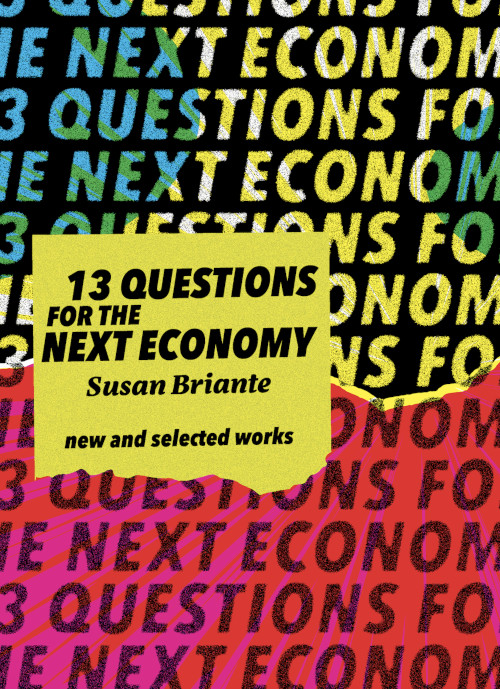
Spurred by this research, several of the works in 13 Questions for the Next Economy take inspiration from both contemporary and historic quests for liberation. For example, my piece “No Where is Outside Mississippi” (originally published in Essay Daily) gathers my reflections on the pamphlet “Emory is Everywhere,” authored by pro-Palestinian student protesters, and Hamer’s above-mentioned speech. In the spirit of Diana DiPrima’s essential Revolutionary Letters, I wrote this lyric prose experiment as a call to action.

Elsewhere in 13 Questions for the Next Economy, the poem “Further Exercises” marks an attempt to grapple with both the lyric’s revolutionary potential and limits. Crafted in the style of a series of writing prompts, “Further Exercises” highlights the ways in which the lyric can be a site for understanding the self in relation to a variety of communities, systems, and histories. However, I also constructed the prompts to underscore the limits of poetry as activism in and of itself. I believe in the power of the lyric to lay bare the subject in all of its complicated relations, complicities, and collaborations. But that understanding constitutes only one individual step out of many in the work toward collective liberation.
As DiPrima famously wrote: “get up. put on your shoes, get/started, someone will finish.”