25

Vidyā
Translated from the Sanskrit by Andrew Schelling

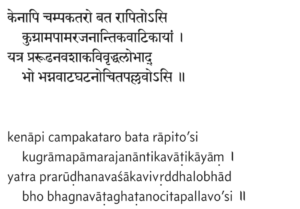
Champak tree

 
who constrained you to this tiny plot
in a shabby 
village?

 
The people are witless—

 
they try to coax leafy greens
from bad soil

 
angrily 
they snap off
your branches—
                      they’ve made you a stump.


Meter: Vasanta-tilakā
Spring Ornament


25

Feature Date

Series

Selected By

Share This Poem

Print This Poem

Vidyā may have been the earliest woman to write poetry in Sanskrit and lived in India between the seventh and ninth centuries. No record of her life exists beyond thirty-odd lyric poems, including some of the best love poems in any language. One scholar coined the term “the Sappho of India” for Vidyā, which succinctly catches both her breathtaking mastery of poetry and the way her writings lie scattered through old anthologies and grammars.

Headshot of Andrew Schelling

Andrew Schelling lives in the Southern Rocky Mountains. His twenty-odd books include poetry, essays, anthologies, and translation. For many years he has studied Sanskrit and Indian raga, publishing eight books of translation. Recent titles include Forests, Temples, Glacial Rivers (poetry) and Old Time Love Song Magic: Sanskrit Poems of Vidyā. His Tracks Along the Left Coast: Jaime de Angulo & Pacific Coast Culture, an ideogram of linguistics, storytelling, bohemian writers, and wilderness, has become something of an underground classic for bioregion thinkers. He teaches poetry and Sanskrit at Naropa University.

Old Time Love Song Magic is two books in one. The first collects Andrew Schelling’s translations of the thirty-odd existing poems by Vidyā, who may have been the earliest woman to write poetry in Sanskrit. The second book draws on the insights and knowledge gained through that process.

"This tantalizing compendium of poetry with commentaries, generously offered by poet Andrew Schelling, arrives at a crucial moment. It is a shimmering reminder, a goad, a puja, a scent of blue lotus, a scold with torrents of rain, a cucumber garden, and crystalline observation that indeed 'every kalpa ends in collapse.' Vidyā—the magnificent wise passionate Sappho of India—soars thru 21st century neurotic mind with deft wit, fierce seduction, ordinary and sublime magic. As if the clouds suddenly lifted to reveal a gnosis and antidote to the Kali Yuga’s intensifying samsara and monstrous war on human imagination! As if love and poetry had abruptly fled a toxic planet of woe—yet heard our call. These elegantly honed translations and their codas of scholarship (with meters: the doe, tiger’s play, girl with a garland) bring us back to life. 'Friend,/ why doesn’t this heart / break into a hundred/ brittle shards?' Vidyā’s voice answers, It does, and reveals the cosmic runes and mirrors of poetry."
—Anne Waldman

Poetry Daily Depends on You

With your support, we make reading the best contemporary poetry a treasured daily experience. Consider a contribution today.