
It is not a ghost town.There is no town.It’s a place.There is a sign and a road.A memory:I was small whenwe drove here. Summer.The long dirt road in.My parents offeredfive bucks to the childwho found David’s gravefirst. Then pulled upto this cemetery. Barelybigger than our yard.Do I remember thisday or my parentstelling this joke?There is no grass.Just fabric flowersthin from sun.A chain link fence.A flagpole.No flag.I do not knowwhich gravesare graves.Some markersonly branchesor ironbars risingfrom dirt.Other headstonesare stonebut illegible. Sandstone after water.Wind. Years.This timeI find Aliceand Thomas first.Their large grey stonegives no hintthat she remarriedafter he died.The stone is new.Replaced maybeforty years ago.Someone I mustbe related to hasstruck six metal polesin the groundaround their graves.Connected themwith a chain.Stuffed plasticflowers downeach pole.The dirt is greyin some places.Pink thenred. Bouquetof red. Fingertip small CoralGilia dragginginto October.
Feature Date
Series
- What Sparks Poetry
Selected By
Share This Poem
Print This Poem
“Pinto Cemetery” from THESE SAINTS ARE STONES: by Millie Tullis.
Published by Signature Books on March 16, 2026.
Copyright © 2026 by Millie Tullis.
All rights reserved.
Reproduced by Poetry Daily with permission.
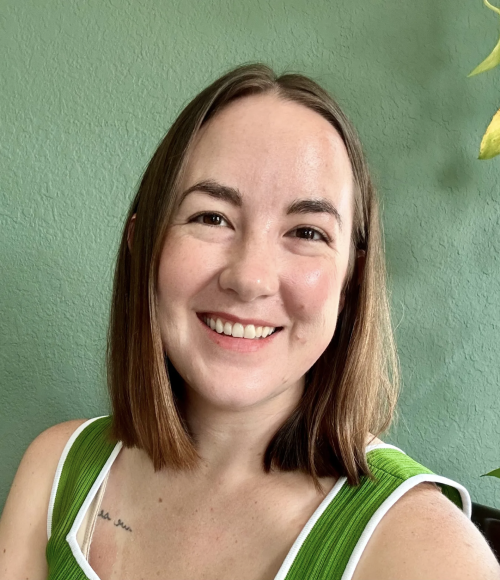
Millie Tullis is a poet, editor, and researcher. Her poetry has been published in Dialogist, Sugar House Review, Cimarron Review, Ninth Letter, and elsewhere. These Saints are Stones (Signature Books, 2026) is her first full-length collection. Millie is the editor-in-chief of Exponent II. Find more at millietullis.com.
In Millie Tullis’s new poetry collection, These Saints are Stones, a faithless daughter is haunted by her third-great-grandmother, Martha, a woman who married her stepfather at sixteen and became a sister-wife to her own mother. Tullis cannot stop uncovering details about Martha, who left no written history behind, and her silence permeates this collection, which is rife with gaps and fragments, scraps of memory that blend with dreams. Sparse and spare, these poems echo the red desert landscape where the speaker’s ancestors lived and died, where she hunts for graves among the rocks and confronts a past she can never fully know. After all, like a sampling of lace, the cloth of women’s history is more hole than thread.
Poetry Daily Depends on You
With your support, we make reading the best contemporary poetry a treasured daily experience. Consider a contribution today.