
You are told to believe in one paradiseand then there is the paradise you come to know.The shoes lined up in pairs by the doorand the herd moving with its mysterious intentacross a dark plain. The blue of the skywhich is the zenith of all colorsand the love of the man in the next room,strong and rough as a hog’s back.My mind has a slow metabolism, it is slowto understand what anything meansbut it understands that if you look at somethinglong enough, it will have somethingto say to you. The sun that is strangely brighton some days, a poisoned canary,and the crop of winter rocks in a meadowin April. Learning decades laterthe name of the hospital where you were bornand watching the child eat a mangoas though it is time he is eating, time shiningon his lips. On fewer days I agreewith the poet’s dread of beingthe wrong person in the right world, and believein adhesion, in never showing upempty-handed, even if the pleasure I know bestis fused with the abject. There is alwaysthe other side of the heart, its coaxing:You are here. You can begin again. You can rise.
Pleasure
Feature Date
Series
Selected By
Share This Poem
Print This Poem
“Pleasure” from Moving the Bones: by Rick Barot.
Published by Milkweed on October 15, 2024.
Copyright © 2024 by Rick Barot.
All rights reserved.
Reproduced by Poetry Daily with permission.

Rachel McCauley
Rick Barot’s most recent book of poems is Moving the Bones, published by Milkweed Editions in 2024. His previous collection, The Galleons, was longlisted for the National Book Award. His work has appeared in numerous publications, including Poetry, The New Republic, The Adroit Journal, and The New Yorker. He has received fellowships from the Guggenheim Foundation, the National Endowment for the Arts, and Stanford University. He lives in Tacoma, Washington and directs The Rainier Writing Workshop, the low-residency MFA program in creative writing at Pacific Lutheran University.
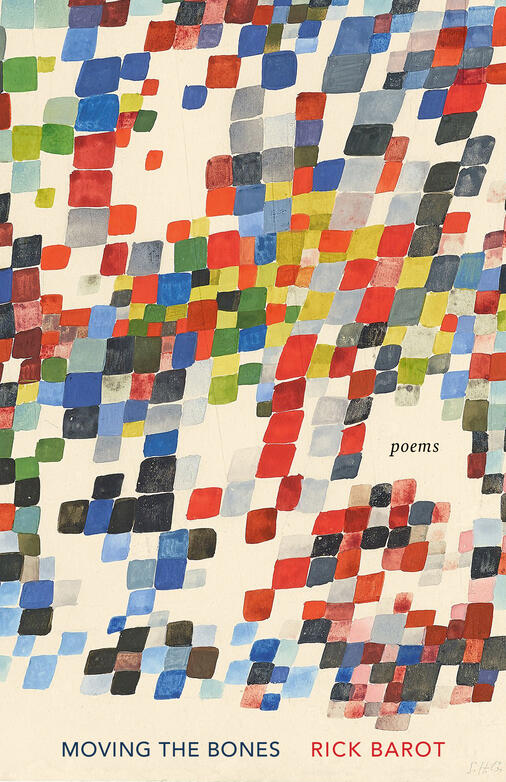
“You are told to believe in one paradise / and then there is the paradise you come to know,” begins Rick Barot. What follows is an account of the rich and thorny valley between those poles. Moving the Bones dwells in liminal spaces—of love and memory, the pandemic’s singular domesticity, a serene cemetery of ancestral plots, dawn. In precise and tender verse, Barot captures the particularities of being in the middle of one’s life, reflecting on the joys and sorrows of the past and confronting the inevitabilities that lie ahead.
For Barot, this presence of mind is an art of being lost in thought. “My mind has a slow metabolism, it is slow / to understand what anything means,” he confides, “but understands that if you look at something / long enough, it will have something / to say to you.” Appreciating a Rembrandt, standing in a Goodwill, watching a boy with a flower behind his ear—we encounter ephemeral murmurs of meaning everywhere, but only by slowing down, listening. If we take time to notice the enduring insights of daily moments, if we praise cherry blossoms, lungs, and crying, we might find it easier to bear the loss of a loved one, the sting of solitude, the body’s decline.
By laying bare his own experiences, Barot brings us close enough to witness the lyrical work of consciousness. Patient and attentive, this collection illuminates the everyday and invites us to find pleasure in doing the same, at every stage of life.

Poetry Daily Depends on You
With your support, we make reading the best contemporary poetry a treasured daily experience. Consider a contribution today.