Search, search for them:In the insomnia of forgotten drains,in the sewers interrupted by the silence of sewage.Not far from the puddles unable to keep a cloud,lost eyes,a broken ring,or a trampled star.Because I have seen them:In that momentary debris that appears in the mist.Because I have touched them:In the banishment of an out-of-work brick,come to nothing from a tower or a car.Never beyond the collapsing chimneysor those tenacious leaves that press themselves to shoes.In all of this.Even in those vagabond splinters consumed with no fire,in those sunken absences suffered by rickety fittings,not far from the names and signs cooling on the walls.Search, search for them:Under the wax drop that buries the book’s wordor the signature from one of these corners of lettersthat brings, swirling, the dust.Near the lost helmet of a bottle,a shoe sole lost in the snow,a razor abandoned at the edge of a cliff.Los Ángeles MuertosBuscad, buscadlos:en el insomnio de las cañerias olvidadas,en los cauces interrumpidos por el silencio de las basuras.No lejos de los charcos incapaces de guardar una nube,unos ojos perdidos,una sortija rotao una estrella pisoteada.Porque yo los he visto:en esos escombros momentáneos que aparecen en las neblinas.Porque yo los he tocado:en el destierro de un ladrillo difunto,venido a la nada desde una torre o un carro.Nunca más allá de las chimeneas que se derrumbanni de esas hojas tenaces que se estampan en los zapatos.En todo esto.Mas en esas astillas vagabundas que se consumen sin fuego,en esas ausencias hundidas que sufren los muebles desvencijados,no a mucha distancia de los nombres y signos que se enfrían en las paredes.Buscad, buscadlos:debajo de la gota de cera que sepulta la palabra de un libroo la firma de uno de esos rincones de cartasque trae rodando el polvo.Cerca del casco perdido de una botella,de una suela extraviada en la nieve,de una navaja de afeitar abandonada al borde de un precipicio.
The Dead Angels
Rafael Alberti is one of the neglected masters of 20 th century literature. But in saying that, I am being very American—Anglophone, U.S.-born, American, to be specific. When I mention to writers from Mexico, from Uruguay, from Spain, the name “Alberti,” it rings familiar as do “Whitman,” “Bishop,” or “Frost” for us. His neglect is not universal
but provincial. And shameful. These translations are, in part, my effort toward absolution.
Feature Date
Series
- Translation
Selected By
Share This Poem
Print This Poem
“The Dead Angels” from Concerning the Angels | Sobre los ángeles ©️ 2025 by Rafael Alberti trans. by John Murillo. Appears with permission of Four Way Books. All rights reserved.

Considered one of the major Spanish poets of the 20th century, Rafael Alberti (1902–1999) was the author of over twenty volumes of poetry, including Marinero en Tierra, Cal y Canto, and La Amante. He also wrote several plays and the celebrated memoir, La Arboleda Perdida (The Lost Grove). His many honors include the Premio Cervantes, the America Award, and the Lenin Peace Prize among others. Sobre los ángeles (Concerning the Angels) is regarded by many as his magnum opus.

Marcus Jackson
John Murillo is the author of the poetry collections Up Jump the Boogie, finalist for both the Kate Tufts Discovery Award and the Pen Open Book Award, and Kontemporary Amerikan Poetry, winner of the Kingsley Tufts Poetry Award and the Poetry Society of Virginia’s North American Book Award, and finalist for the PEN/Voelcker Award for Poetry, the Hurston-Wright Legacy Award and the NAACP Image Award. His other honors include the Four Quartets Prize from the T.S. Eliot Foundation and the Poetry Society of America, the Lucille Clifton Legacy Award from St. Mary’s College of Maryland, two Pushcart Prizes, two Larry Neal Writers Awards from the DC Commission on the Arts and Humanities, the J Howard and Barbara MJ Wood Prize from the Poetry Foundation, an NYSCA/NYFA Artist Fellowship, and fellowships from the National Endowment for the Arts, MacDowell, the Bread Loaf Writers Conference, Fine Arts Work Center in Provincetown, New York Times, Cave Canem, and the Wisconsin Institute for Creative Writing. Other publications include Dear Yusef: Essays, Letters, and Poems For and About One Mr. Komunyakaa, coedited with his wife, the poet Nicole Sealey, from Wesleyan University Press; and Concerning the Angels, his translation of Ralphael Alberti’s poems, from Four Way Books. Recently, he served as associate professor of English and director of creative writing at Wesleyan University, where he founded with Wesleyan University Press, The Cardinal Poetry Prize, the first ever book prize for poets 40 and over. He is a professor of English and teaches in the MFA program at Hunter College.
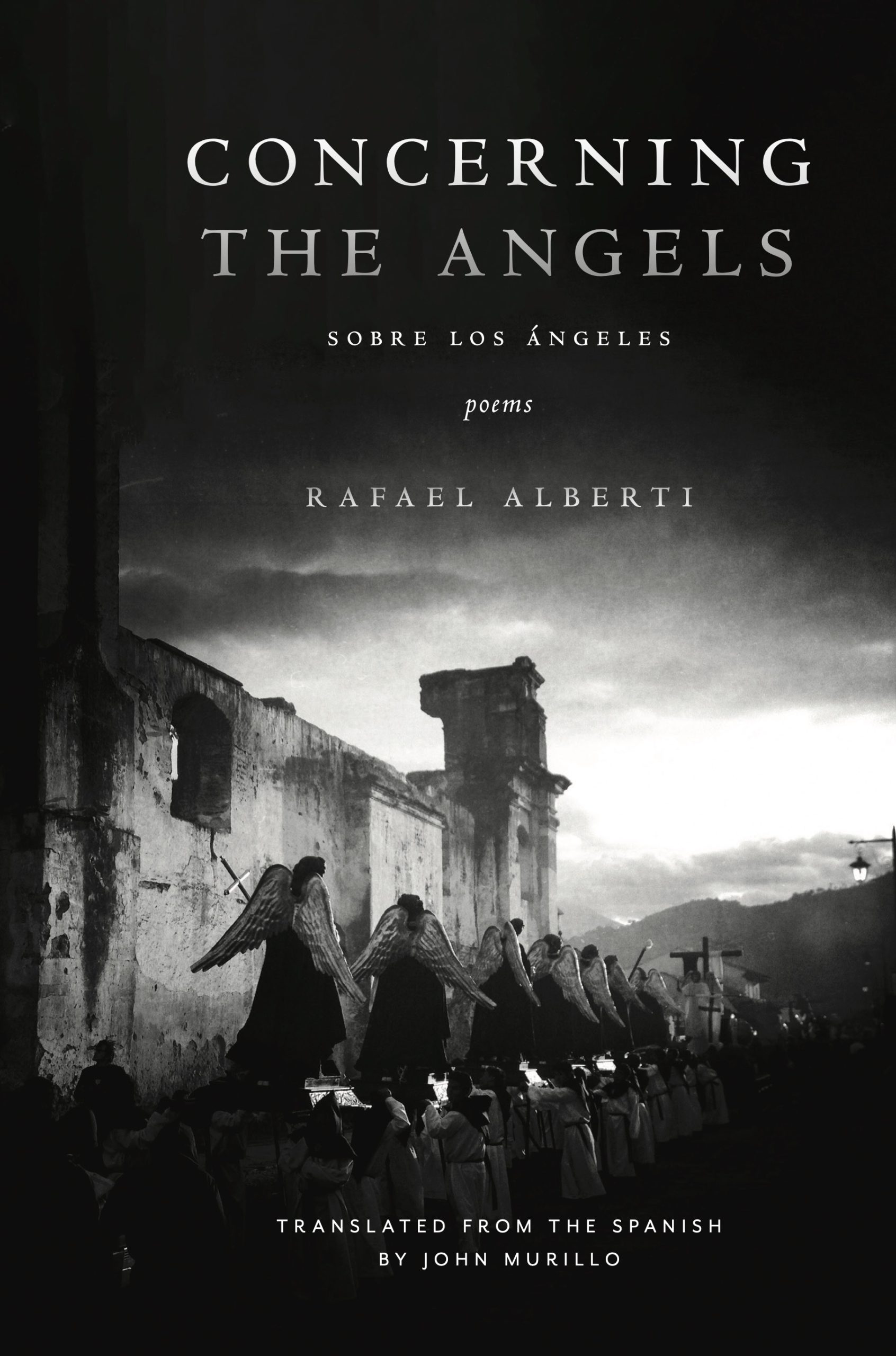
In his first full-length translation, celebrated poet John Murillo (Winner of the Kingsley Tufts Award and the Four Quartets Prize) brings Rafael Alberti’s Concerning the Angels (Sobre los ángeles) to an English-reading audience. Murillo’s foreword introduces Sobre los ángeles as “a monument—albeit a severely neglected monument—of early twentieth-century literature.” Despite having “penned a masterwork of social and psychic malaise as deserving as any of its place in the global canon,” Alberti has disappeared into relative obscurity among readers of English language poetry, and Murillo’s crucial intervention allows the Spanish poet’s voice to once again echo prophetically from this book’s opening poem, “Paradise Lost”: “throughout the centuries, / through the nothingness of the world, / I, without sleep, search for you.” Insofar as the speaker addresses a figure named Shadow, he also seems to imagine us, his future readers, who need these prescient lyrics written in the time leading up to Spain’s civil war and ensuing decades of fascist rule. Bringing his signature gifts to translating from the Spanish, Murillo has given new life to what many consider Alberti’s magnum opus and delivered our marching orders for the resistance the future will require. “It is time you gave me your hand / and scratched into me the little light that catches a hole as it closes / and killed for me this evil word I plan to plunge into the thawing earth.”

Poetry Daily Depends on You
With your support, we make reading the best contemporary poetry a treasured daily experience. Consider a contribution today.