
Two people are asleep in a field.The light is not yet up. The air is cold, even though it is summer.I cannot get closer than where I am. I know only so muchabout them. I know they are not dead.I know they are asleep because one of them has moved, just enoughto show it is a movement you make in sleep, an adjustmentof resting weight. I don’t know if it is romanticthat they are in this field. Or if it is drunkenness or despair.From this distance their clothes are black.They are two men, or a man and a woman,or two women. I am not near enough to learn what their bodies are,or how proximate or distant from each other.It is the corner of my eye that has seen them,walking quickly past. It is a corner of my mind that has seen them,a startled glance, then that glance widening.They have no belongings, no things that speak of displacement.The field is askew with untended grass, except wherethey have flattened it. Have they been here the full lengthof the night, or just the previous hour?Who are they for whom the grass is a bed? Who are those others,elsewhere, sleeping in the open back of a truck,or on the ground behind a guarded fence?I am walking in the countryside, so maybe they are people of myth.Or they are people of a labor I know nothing about.There are birds singing to the dawn. There is the soundof a big wheel rolling somewhere. There are trees,as tall as parents, but they have not slept under them.In the dark, alone, I went out to see the turn towards morning.Then I saw them. What the imagination would do with two peoplesleeping in a field is keep them where they are,unknowable, untouched. The imagination also wants themto stir, to wake them back into their stories.The day will be hot. The smell of yesterday’s heatis still in the air, like the sweat of a body. What would bring meto a field in the night and have me sleep there?Whose hand would I be holding, out of desire or fear?My pants’ hems are heavy with dew. I know how far awayI am from everyone. Am I a child again, am I old?Or am I only who I am now, astounded at the transport of the bodyfrom one end of time to another.
Feature Date
Series
- What Sparks Poetry
Selected By
Share This Poem
Print This Poem
“The Field” from MOVING THE BONES: by Rick Barot.
Published by Milkweed Editions on October 15, 2024.
Copyright © 2024 by Rick Barot.
All rights reserved.
Reproduced by Poetry Daily with permission.
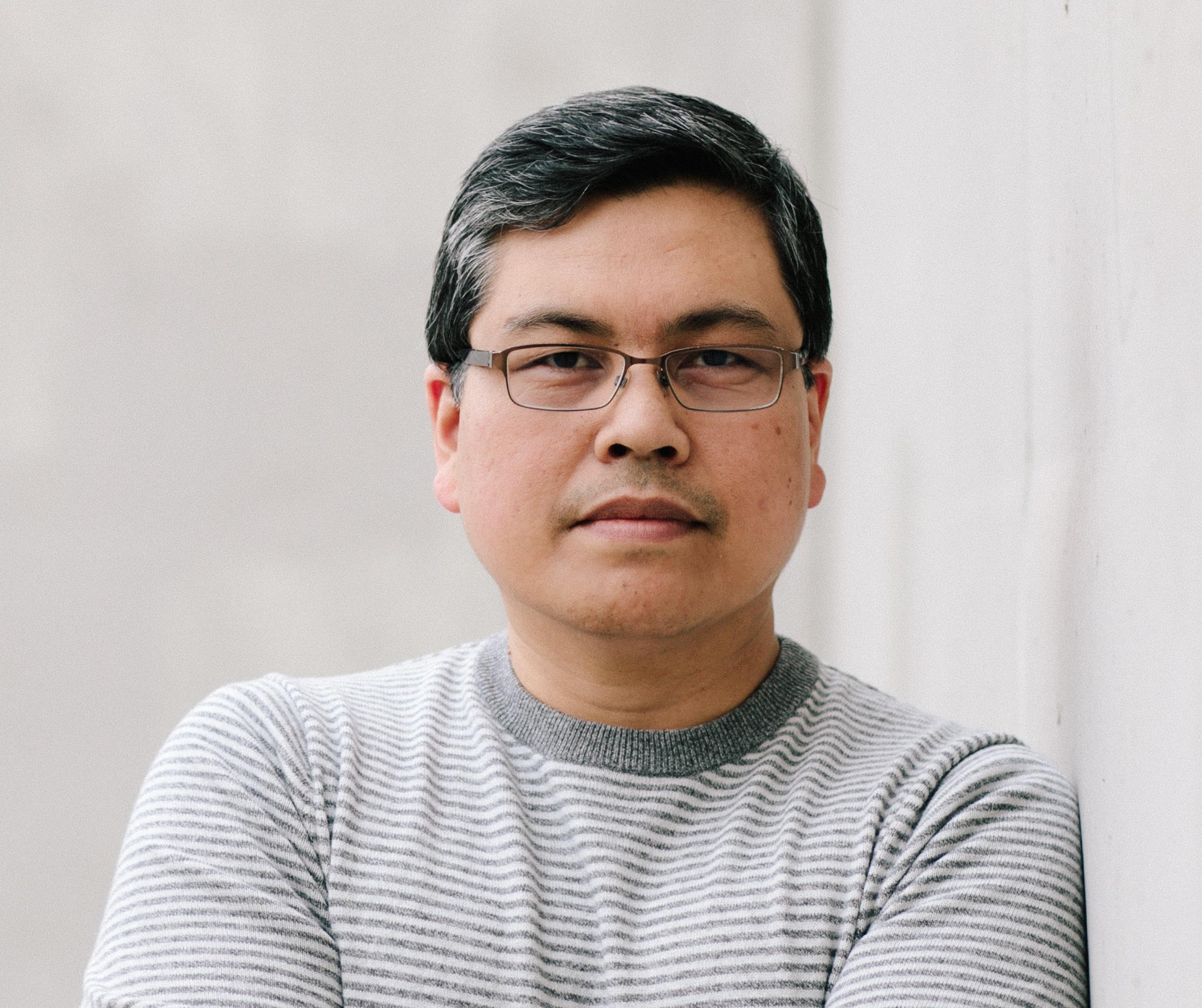
Rick Barot’s most recent publications are a book of poems, Moving the Bones (Milkweed Editions), and a chapbook, The Emperor of the Cut Sleeve (Sixth Finch Books). His work has appeared in numerous publications, including Poetry, The Kenyon Review, and The New Yorker. He has received fellowships from the Guggenheim Foundation and the National Endowment for the Arts. He lives in Tacoma, Washington and directs The Rainier Writing Workshop, the low-residency MFA program in creative writing at Pacific Lutheran University. His next collection, Shadow Machine, will be published by Milkweed Editions in 2028.

“You are told to believe in one paradise / and then there is the paradise you come to know,” begins Rick Barot. What follows is an account of the rich and thorny valley between those poles. Moving the Bones dwells in liminal spaces—of love and memory, the pandemic’s singular domesticity, a serene cemetery of ancestral plots, dawn. In precise and tender verse, Barot captures the particularities of being in the middle of one’s life, reflecting on the joys and sorrows of the past and confronting the inevitabilities that lie ahead.
For Barot, this presence of mind is an art of being lost in thought. “My mind has a slow metabolism, it is slow / to understand what anything means,” he confides, “but understands that if you look at something / long enough, it will have something / to say to you.” Appreciating a Rembrandt, standing in a Goodwill, watching a boy with a flower behind his ear—we encounter ephemeral murmurs of meaning everywhere, but only by slowing down, listening. If we take time to notice the enduring insights of daily moments, if we praise cherry blossoms, lungs, and crying, we might find it easier to bear the loss of a loved one, the sting of solitude, the body’s decline.
By laying bare his own experiences, Barot brings us close enough to witness the lyrical work of consciousness. Patient and attentive, this collection illuminates the everyday and invites us to find pleasure in doing the same, at every stage of life.

Poetry Daily Depends on You
With your support, we make reading the best contemporary poetry a treasured daily experience. Consider a contribution today.