
Run down, or risenFar enough to catch the moon’s reachFor trees aglow with chlorine in their leaves and garlandsFrom a long-gone national holidayThat wants me to wake up awake, holding onTo which expectation just ahead? If you have to ask, moon child, You’re already glowingYour silver face and our only friends in the sky,The doddering in their eyesLooking down to this pool deck,Barrel cactus, pink gravel Having been seenComes with its own annotationsI’ll go to sleepAsleepUnwelcomed but heldBy a word just behind
Feature Date
Series
- What Sparks Poetry
Selected By
Share This Poem
Print This Poem
Reprinted with permission from Moon Mirrored Indivisible by Farid Matuk, published by the University of Chicago Press.
© 2025 by The University of Chicago.
All rights reserved.

Farid Matuk is the author of the poetry collections This Isa Nice Neighborhood (Letter Machine Editions, 2010), The Real Horse (University of Arizona Press, 2018), and Moon Mirrored Indivisible (University of Chicago Press, 2025). With visual artist Nancy Friedemann-Sánchez, Matuk created the book-arts project Redolent, recipient of the 2023 Anna Rabinowitz Prize from the Poetry Society of America. From Spanish, Matuk has translated Tilsa Otta’s selected poems, publishing these under the title The Hormone of Darkness (Graywolf Press, 2024). His poems appear in The Paris Review, The Nation, Brooklyn Rail, Bomb Magazine, Lana Turner Journal, Poetry Magazine, among others, and they have been anthologized most recently in The Best American Experimental Poetry and the Library of America’s Latino Poetry. Matuk’s work has been supported by residencies from the Headlands Center for the Arts, a visiting Holloway Lectureship in the Practice of Poetry at the University of California, Berkeley, and a 2024 USA Fellowship from United States Artists.
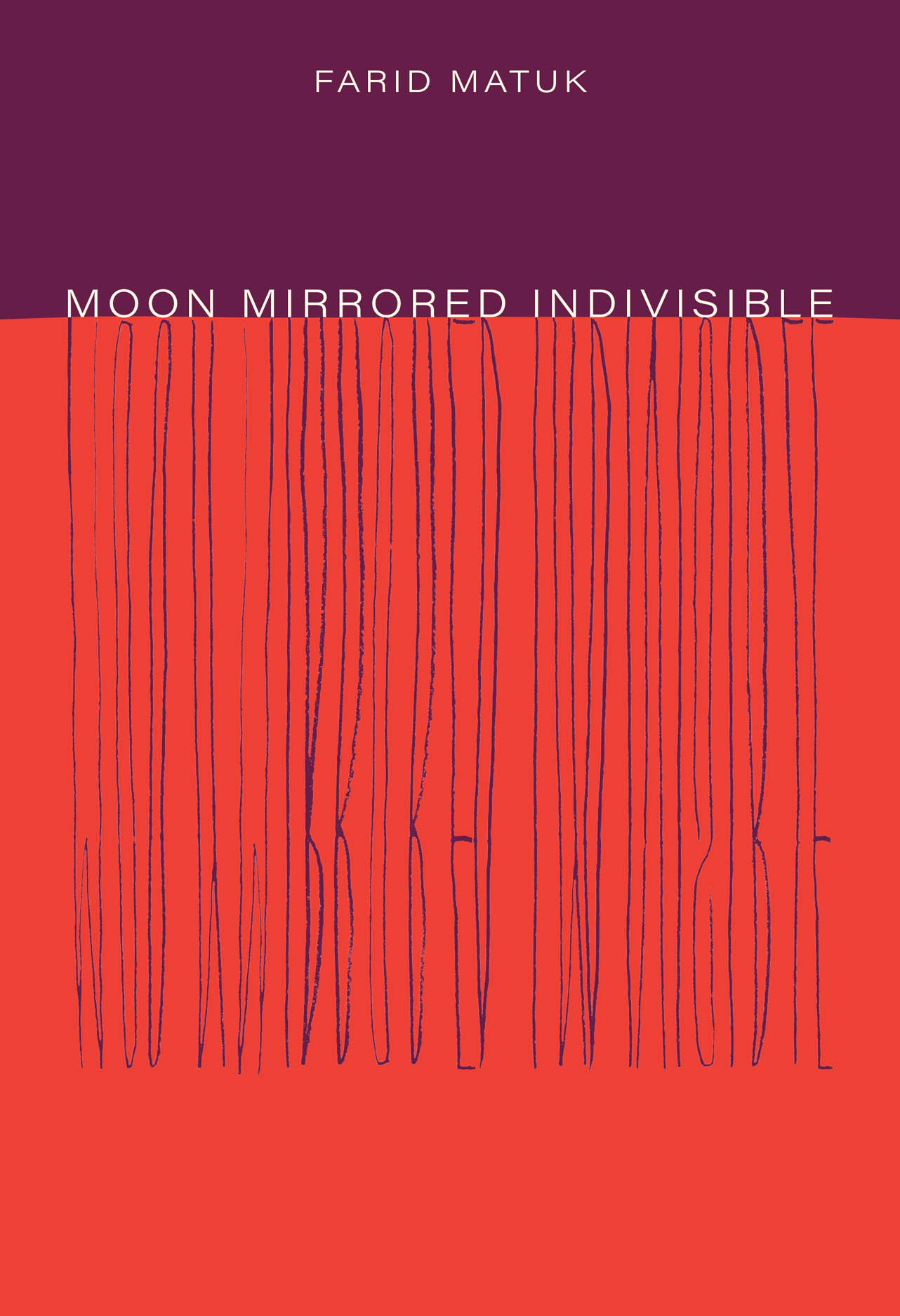
A previously undocumented child of Syrian and Peruvian parents, an inheritor of lineages marked by colonial and gendered violence, and a survivor of childhood sexual assault, Farid Matuk approaches the musical capacities of verse not as mere excitation or decoration, but as forms that reclaim pleasure and presence. Entering the sonic constellations of Moon Mirrored Indivisible, the reader finds relief from nesting layers of containment that systems of power impose on our bodies and imaginations. In this hall of historical mirrors, fictions of identity are refracted, reflected, and multiplied into a vast field of possibilities. Matuk’s meditations on place and power offer experiments in self-understanding, moving through expansive conversations between a lyric “I” and others, including poets, the speaker’s partner, ancestors, and the reader, and creating spaces for strange intimacy. Each of the book’s four sections of poems builds on the other to ask how we might form a collective—a people—not founded in orthodoxies of originality but in the mutual work of mirroring one another.

Poetry Daily Depends on You
With your support, we make reading the best contemporary poetry a treasured daily experience. Consider a contribution today.