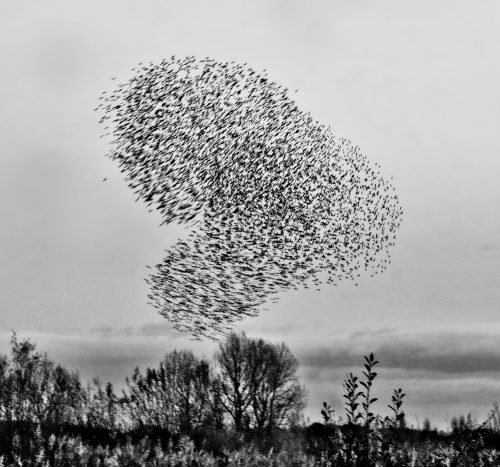
I don’t remember where I was coming from, but when I arrived home, I ran into the house, the front door open as it always is in summer. I had to see what I just heard described on NPR—a short film shot in the Wadden Sea in Denmark by photographer Søren Solkær. My monitor blackened into an undulating, roaring cloud like an ocean of tar crashing over me. Gyrating above a gray landscape, sweeping closer to the camera, the dark mass pixelated into birds. Millions of starlings flying in unison. A murmuration.
Mesmerized, I played the film again and again. Then called my husband in to watch. He leaned over my shoulder. Stunning, he said, before returning to whatever he was doing, and I to following a bird into the internet depths to learn the cause of starlings’ murmuration. Fear, I read. Miniscule fears triggering one starling to alter the flock’s direction.
I know small fears that arise out of nothing, that fly across my mind in the middle of night, that seemingly nest in my heart, startle my adrenaline into a flurry as I go about an ordinary day. Fears that I have suppressed for years under the guise of an easy confidence, a flourish of control.
Like the event that triggers a murmuration, I’m not certain what set me to start drafting “Even Now After All These Years.” Just that it flowed quickly that afternoon. Gathering momentum as my mind darted from Denmark to Hamlet to the arrival of starlings into Central Park as homage to Shakespeare. But there in the poem that began forming from words flocking to the page was my love for my husband, vulnerable, exposed.
In the NPR interview, the photographer Solkær described murmuration as the “perfect collaboration….a ballet of life and death.” I’d come to this marriage bruised from the previous one, but with my sense of self restored. And met someone who had never lost his. So, in middle age,
we found each other before a congregation, vowing unison.
From a distance, the starlings appear as a single throbbing heart in the evening sky. With closer proximity, the individual birds emerge into view. I see each one separate but flying in the same direction. Isn’t this what we have in our marriage? But my poem, like the reflection off the Wadden Sea, seems to say something else.
For love of Shakespeare, we speak starling, our mouths black with feathers.
I want to dance. But you refuse to lead. Isn’t that a form of backstepping,
of creating space between us? In the wingspan of distance
from your body to mine, we could hold a lit candle or a child.
We’d been together for over a dozen years when I wrote those lines. Drawing closer with time, and with the challenges of blending two established, independent lives into one. He, childless and never married with no remaining family to speak of, and me, with three children, ex-husbands and a large, tight-knit family. Building something new for the two of us.
Over the years, we’d realized some of the dreams we hatched together in the beginning, and others had fallen away. Perhaps leaving a space, a distance between my husband and me into which uncertainty had lodged its fistful of little fears.
So, when you tell me you still love me,
it wings past me. Say it again, louder. You know I’m a flight risk.
When a poem arrives nearly fully formed with astonishing speed like “Even Now After All These Years” did, I take it as a missive from my unconsciousness, that mistress muse that shows up to turn up the volume, to demand I pay attention. To pay attention to my marriage—the one where I thought I had finally found that “perfect collaboration.” Why was I letting doubt set in and expand into the small fissures that my fears created? Why couldn’t I have faith in my husband’s love? Why couldn’t I have faith in my own?
And then I did the usual, I shelved my uncertainties as the poem winged into the world before I wrested it to include in the tic tic tic collection, and read it anew. Ah that Rilke moment! There, once again, my life exposed on the page—“for here there is no place/that does not see you.”
So, I did the unusual, I read, then discussed my poem with my husband, not just the lines but everything between the lines. A conversation that sputtered and winded over time until it led to a deepening, what I would call “spiritual,” and my husband would describe as “we’re good.” We are after all, different birds! Yet, decidedly in union for this “ballet of life and [and ultimately] death.” As a flight of starlings inspired a poem which inspired my relationship, I decided to continue the circle, setting birds free within tic tic tic. They alight on the branches of poems and accompanying photographs throughout the collection, gathering strength, uniting in murmuration.
When Solkær’s “Black Sun” film and photography arrived as an exhibit at the National Nordic Museum near us in Seattle last year, my husband and I went together. It was winter, the season when the starlings gather over the Wadden Sea. The day was gray, as in many of the photos sweeping the broad walls. Alone in the exhibit, we felt the murmuration like a vibration between us:
Stunning you say, meaning the murmuration of birds—
improbable beauty on an otherwise ordinary day
before we walked out into the darkening afternoon.