
1.Oncein the woodssnake camelike a whiplike a piece of a circlelike black waterflowing down the hill.“Watch me,”it whispered—then pouredlike black waterthrough the field—then hurried down,like black water,into the mouse’s hole.And out of thisyou might drawthe thinnest of shining threads—whirl it around andfling it into the air,fling it into the air—again and again it will land on the earthcrimped and cursive,but spelling nothing,for, dear God,we too are down herein such darkness. 2.It is easy to fall down on your kneeswhen the shining rain begins to happen.It is easy to be thankfulfor the bundles of wild rosesledged along the dune.It is as easy as if you were yourself a flower in the field, the rain tossing you and tossing you,until you are that flower— as torn as muddy as golden as that. 3.The snake never shuts its eyes. 4.I have lit candles. (Though I am not ready, I am willing.)I have placed one word next to another to build something full of praise.I have admired the hummingbird, dazzling among the lilies.Also the tooth of the otter, the compost pile, the first star in the evening sky. (Though I am not ready, I am simmering.) 5.And certainly and easily I can seehow God might be one rose bud,one white feather in the heron’s enormous, slowly opening wing.It’s after thatit gets difficult. 6.The snake never shuts its eyes.The mouse sits tight. 7.The good shepherd of the fields, whoever he is,has so many wonderful and saucy tricks.I want to find him,I want to discover just one more trick.Oh, nobody runs so hardas the doubters running over the hot fields crying out for faith, looking for it in the high places and the low places, looking for it everywhere,oh, see how I run! 8.The snake never shuts its eyes.The mouse sits tightin the beautiful field. 9.I went down all alone, to the black pond.Slow summer day.No one around.Not even a bird singing, not a wind awake, nothing.Yet nothing could ever convince methat I was alone.If God exists he isn’t just butter and good luck—he isn’t just the summer day the red rose,he’s the snake he’s the mouse,he’s the hole in the ground,for which thoroughness, if anything, I would adore him,if I could adore him.Adore him. 10.The first streak of light in the darkness,the first bird to sing,the first whale to rise out of the black water,the first morning of the spring tidethe first lupine geranium poppyfirst sweet corn,the first afternoon spent outdoors, after illness,first childspeaking its first wordsfirst peach on the treefirst grapesfirst hand-holding first kissfirst afternoon of snowflakes like salt tapping the leavesthen the swirl then the soft clouds tumbling downfirst road to the ocean,first smell of the oceanfirst white heronfirst abalone,first crab, iridescent in the seaweedfirst mountainfirst fernfirst egg with a tapping from insidefirst rosered rose first white rose openingitself and no more than itselfand more than itself. 11.The pickerelswims up from the pond from its roses of slow decay, andlooks at meastonished.What is it I need to know?The gypsy moths, still caterpillars,wrench themselves from the milky shreds of birthand set out on the long journeyin the shining tree.What is it I don’t know that I need to know? 12.Think of mewhen you see the evening star.Think of me when you see the wren the flowing root of the creek beneath him, dark silver and coldRemember me I am the one who told youhe sings for happiness.I am the one who told youthat the grass is also alive, and listening.alleluiah alleluiahsighs the pale green mothon the screen door,alleluiah alleluiahthe red tongues of the white swansshine out of their black beaksas they shoutas their wings rise and fallrise and falloh rise and fallthrough the raging flowers of the snow.
Evening Star
Feature Date
Series
Selected By
Share This Poem
Print This Poem
Adapted from LITTLE ALLELUIAS: Collected Poetry and Prose by Mary Oliver, Foreword by Natalie Diaz, published on September 9, 2025. Copyright © 2025 by Natalie Diaz. Used by arrangement with Grand Central Publishing, a division of Hachette Book Group. All rights reserved.

Rachel Giese
Born in a small town in Ohio, Mary Oliver published her first book of poetry in 1963 at the age of 28. Over the course of her long career, she received numerous awards. Her fourth book, American Primitive, won the Pulitzer Prize for Poetry in 1984. She led workshops and held residencies at various colleges and universities, including Bennington College, where she held the Catharine Osgood Foster Chair for Distinguished Teaching. Oliver died in 2019.
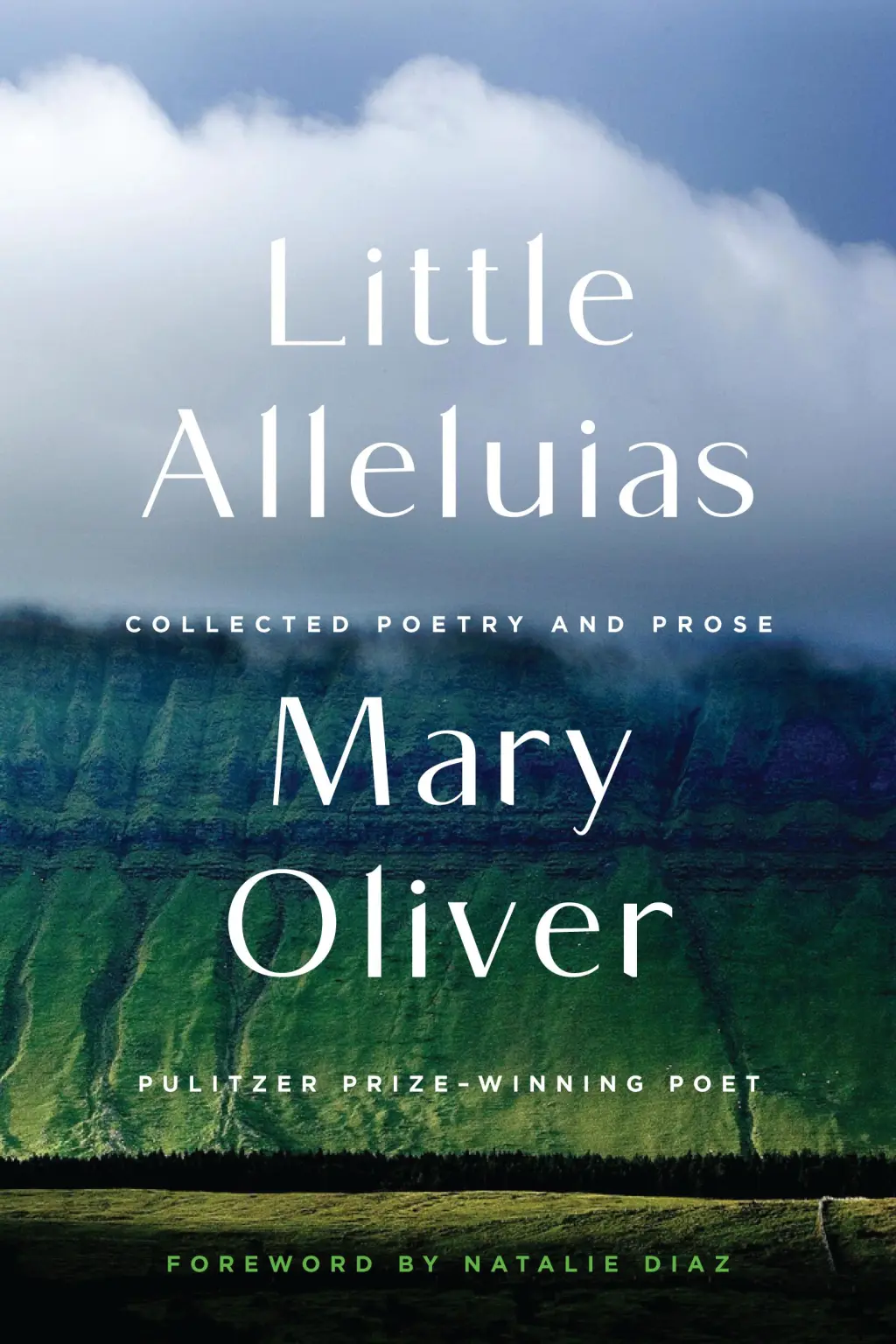
An archival compendium of three complete works by Mary Oliver: the book-length poem The Leaf and the Cloud, the collection What Do We Know, and essays from Long Life—with a foreword by fellow Pulitzer Prize-winning author of Postcolonial Love Poem Natalie Diaz.
For the many admirers of Mary Oliver's breathtaking poetry of touch and transcendence, as well as for those coming to her words for the first time, Little Alleluias is a revelation.
These works observe, search, pause, astonish, and give thanks to both love and the natural world. In constant conversation with the sublime, (i.e. "Are you afraid? / Somewhere a thousand swans are flying / through winter's worst storm."), Oliver has the rare skill of rendering life: her poems and essays bring movement to stillness, and people to the Earth, themselves, and each other. Page by page, she invites us to walk through her minutes, her moments, and revere the light and dark and rainbowed clothes of world alongside her.
With three distinct books collected in one volume for the first time, Little Alleluias asks what passes and what persists, and offers readers the peace that every mind deserves.

Poetry Daily Depends on You
With your support, we make reading the best contemporary poetry a treasured daily experience. Consider a contribution today.