Introduction
I came across Perry Janes’ work in an acquisition mountain of books sent to Poetry Daily. I was immediately drawn to the colorful explosion that is the book’s cover, along with its soft challenge of a title, Find Me When You’re Ready. If the cover and title hadn’t intrigued me enough to dive into Jane’s debut collection, a raving review on the back from this year’s National Book Award finalist Gabrielle Calvocoressi saying that “if a book could be your best friend…that book would be this book,” sealed the deal.
Filled with a vast variety of forms, Find Me When You’re Ready bravely monkeybars through memory, identity, and trauma like a playground. After reading the entire collection in one sitting, I was left fascinated by the book’s ability to both terrify and comfort me at once: I had indeed found a new friend. As a poet who has done a lot of trauma-centered work both professionally and personally, I was and am deeply drawn to the way that Janes somehow captures the necessary discomfort that comes with processing a trauma (which in the case of this book is childhood sexual abuse) while also maintaining a burning priority for questioning.
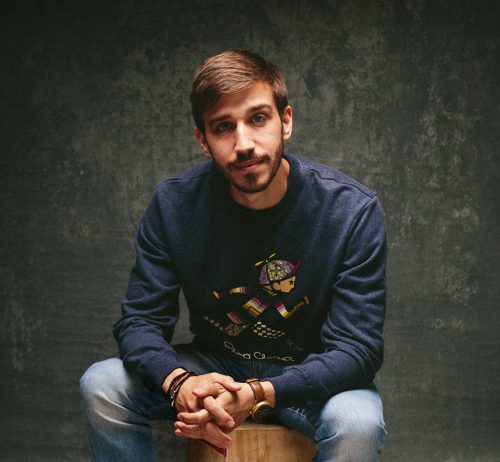
On January 14th, Perry and I hopped on a zoom call amidst his settling into a new apartment in California so that we could dive into his debut collection.
Michaela Godding: The title of your book, Find Me When You’re Ready, felt like a soft invitation, but also a challenge. I’m wondering, why did you choose that as the title of your book, and when did it come to you?
Perry Janes: That’s a good question. I’m actually not sure if I’ve been asked about the title before, which is funny coming off of a long book tour in the Fall. There’s a boring mechanical answer and a more spiritual answer, but the boring mechanical answer is that early on with the text I found myself foisting titles onto it that felt wrong—felt prescriptive, that felt too directional. And so I challenged myself to go through the body of the text to pull out any lines that were already existing in the poems that felt like they maybe spoke to what I wanted readers to first encounter when opening the text, and that’s how I found the line “Find Me When You’re Ready” which comes from the poem Killer of Sheep in the book.
More spiritually, I felt like I had to find my way to this book when I was ready as a poet and as a writer, given the subject matter. I think given the sort of narrative of the book being a coming of age story and moving from childhood into adulthood, spiritually it felt like—I like how you used the word invitation—it felt like the right invitation to the reader, to say, “ok, maybe this isn’t for you now, maybe this is for you later, but I hope it does find you when you’re ready for it”.
MG: I totally felt that in finding it. Now, of course in poetry there are no rules at the end of the day, but I’m curious as to why you decided to label the different sections of your book into “acts”. Was you choosing to label each section of your book as an “act” at all related to the greater idea of performance? And how did you go about deciding to separate it into five sections?
PJ: So the first answer is that initially I was sequencing the book very elliptically. I was kind of following theme—I was following form. I was looking at a very micro level at the way that each poem dynamically led into the next in terms of energy and content. And then I gave the text over to a friend and colleague of mine and they called me and said, “..what is wrong with you? You are a screenwriter by trade. You write very structured narrative. What you have written here is this coming of age story with a very consistent through line.” They pushed me to see what would happen if I just put the poems in linear order, as I understood them. I felt like that really unlocked a kind of new dimension in the text. It also felt incredibly authentic to me and my work as a writer, artist and creator.
The five acts came about because I was looking at the poems in linear form and it started to feel too large a narrative story not to break up into sections. The one that most interested me was the five-act structure, particularly because in a five-act structure it locates the climax in act three, so the climax happens at the middle of the story, which is not something that we’re used to in most Western storytelling. When you think about movies and television shows like Stranger Things, the climax is at the very, very end of the story, right? What I like about the five-act structure is that it honors the idea that there is just as much story to tell on the other side of the reverberations and the echoes and the fallout of a climax as there is leading up to it, which was the real primary driving motive ultimately to create the book in this five-act structure, and to put the poem that we’re talking about today as that sort of climactic Act Three standalone piece.
MG: I think that that structure also rings so true to poetry—that there’s something after and before everything, and that we can witness those things even though they’re not present.
As you mentioned, all of the acts in your book are a similar length except for Act Three, which is exclusively the poem, You Keep Asking The Question. We Keep Answering. The poem is my favorite in the book, because it really moved and impressed me in its lengthy commitment to disfiguring memory.
The poem opens with the lines:
Mama made a batch of blueberry pancakes
that day. I remember the dough
stuck to every surface—
Mama? What Mama. I had friends.
I mean boys. There were three of us—
five of us—
two—
one of them in particular.
The speaker’s tone feels so exact despite offering constant contradictory details by skipping between a nonlinear recollection of abuse, which to me, uncannily encompasses the endless spiral that often comes with recounting a traumatic event. Do you feel that this poem came from and captures the violence of attacking or questioning the factual truth of memory, or that it instead honors how the rewriting of memory can make a past experience feel more emotionally true or correct?
PJ: What a thoughtful question, and thank you for such a close read of this poem. I think the answer is both and yes. I think that in some regards, the initial drafting of this poem speaks to your sort of first point, right, that there was a kind of enactment of that kind of violence within the poem itself. And then in the subsequent revision and rewriting and rethinking of the poem, it became more of an embodiment of that second idea and spirit. And I think the third thing that I would say, just formally about this particular poem, is that when I began writing about trauma with a capital T, as it were, I was writing poems that I would describe as very declamatory, right? And so they were sort of defiantly laying claim to the facts of this experience. I think I would have thought of them at the time as boldly vulnerable.
Then I gave them to a mentor of mine and they came back to me and said something I thought was really thoughtful. They said that what’s so interesting about these poems is that they’re so very specific and exact and open about this experience in a way that simulates vulnerability, but tonally, they were armoring the reader, and myself, from any sense of actual vulnerability. They’re layered in certainty. They’re layered in proclamation. The syntax is very declarative. The lines are end-stopped. There’s this sort of enactment of proclamation, right? And so I realized my purported attempts to achieve vulnerability were actually keeping the poems at an arm’s length. So with this particular poem, along with many other poems throughout the book, I began to ask myself how I can interrupt those patterns of proclamation and how I can interrupt my own systems of certainty around a particular event—how I can embrace and open myself and the poem up to a vulnerability in form by allowing contradiction and questioning. I think that that really came to a head in this particular poem, which is as fragmented as any poem in the book.
MG: Yeah, that makes sense. And I also love that in that particular poem it was less of a choice and more of a process. That’s one of the reasons why I love poetry. Cause it’s like, what else can do that, you know?
PJ: Totally agree.
MG: So with that poem still, I found myself believing in the heart of the poem, even though it was promising to lie to me.
PJ: Right.
MG: I feel that the form for You Keep Asking The Question. We Keep Answering, at least in regards to its length, offers a purposefully elongated discomfort. It’s uncomfortable. That perhaps may be the content itself, but I’m curious how you feel about the final form of that poem, and if you feel that a form of a poem can offer a truth that the words of a poem itself can’t?
PJ: Absolutely. I 100% could not agree with that thesis more. That exactly is what keeps me coming back to poetry. I sometimes describe myself as an undercover formalist. I agonize over every word and lineation and punctuation right within the poem, I enjoy that, but I do think that form is what makes poetry so unique from other forms of writing, particularly from any form of discursive writing…the use of the em dash to constantly interrupt or to sharp pivot into direct contradiction, to juxtapose what might otherwise be both factually and tonally dissimilar. I suppose my hope is that that enacts a kind of searching, right? It brings the reader into that process of confronting something with uncertainty, with discomfort, with trauma, with hope, with growth, and embodies the constant turns and shifts and ways in which memory often wrong foots us.
MG: There’s all sorts of forms being taken on in your book, which is another thing that really impressed me throughout your collection. I’m wondering, as someone who utilizes so many forms, how do you know when a poem’s form has reached its final point? When can you finally say, okay, this is the end, this is it, I’m leaving it alone?
PJ: Wow. I think to some extent, that question is actually harder with free verse poems very often, right, as opposed to received forms. When it comes to the sonnet, the pantoum, the villanelle, the rondo redouble, many of which appear in this book and in other poems that I’ve written, there’s a received set of rules that come with each. Part of what is so satisfying about working in received form is that it forces you to distill, I think, both what you want to say discursively, and how you want it to sound. On the other hand though, many of the forms in this book also are slightly looser forms, like the contrapuntal that you have to turn sideways to read, which is a riff on the double jointed poem that Tyehimba Jess invented in his book Lead Belly.
This is actually a difficult question for me to answer because I work across not only many different forms in poetry, but also just many different forms of writing. I also publish my fiction writing. I make my living as a union screenwriter. And so with every idea that comes to me, there is this sort of immediate confrontation with what it wants to be. So the first layer of that is, does it want to be a script? Okay, if it’s a script, does it want to be a TV show? Does it want to be a film? Does it want to be a short story? Does it want to be a novel? Does it want to be a poem? There’s this immediate sort of filtration process of the idea, the emotion, the character, the spirit of whatever it is that over many, many years of doing this has become a kind of muscle memory.
And I think that that has trickled down into how I approach my poems specifically. If you were to look at my very, very messy archiving system in Microsoft Word for all the poems that I write, you would find that many, many of my poems do cycle through a lot of different forms before they ultimately find themselves, so it’s not unusual that I’ll draft a poem in free verse and then I’ll think, well, hey, this poem is interested in a kind of recursion of image or memory or experience. So then I’ll make it into a pantoum, and I’ll think, okay, well, the structures of this form aren’t quite offering me enough space to say the things that I want to say. So maybe let’s try inventing a form! Or maybe let’s try just embracing a free verse form of that particular poem that plays with repetition in a conscious way. I’m always searching for the container for the poem that embodies something about the poem, and that, for me, is really central to my theory of poetics.
I didn’t answer your question, I’m sorry, about how I know when it’s done. I’m not sure we ever fully know beyond a feeling—beyond a sort of instinct of completion, and maybe more than anything else, an absence of a feeling, which is to say that very often when a poem isn’t ready, there’s this part of me that knows and wants to avoid confronting that knowledge. But there’s a part of me that knows, and I find I very often know when I share the poem with someone else, when I give it to an editor, when I send it out for publication, when I show it to a friend, and I feel exposed, because I am aware that that poem is trying to play fast and loose. It’s trying to get away with something. And so maybe the best answer I have for that question of knowledge, of completion is, I listen to an absence of that feeling.
MG: Being a multidisciplinary artist, have you ever gone down the track of one genre with something and then realized, oops, it should actually be this, and then it became something else?
PJ: Yeah, I have, actually. It doesn’t happen often, but it does happen. And sometimes it exists in multiple different iterations. That happened with the poem in my book, Parable of the Golem. It began as a short story, didn’t work, became the poem as you see it, and then subsequently became a feature film screenplay that I still remain pretty proud of and interested in, but is one hell of a tough sell in Hollywood, so we’ll see if it ever gets made. It has even subsequently begun to morph and mutate again into the beginnings of what may or may not ever become a finished novel, but it’s something that I’m working on and playing with. There are certainly ideas, concepts, and worlds that stick with me and sometimes do sort of transmute from one form into another, but I would say that probably more often than not, once I feel confident that something has really found its form, it tends to live there.
MG: I’m rooting for that film! That’s awesome.
PJ: Thank you so much.
MG: I’ve shared with you that in my poetry I write about or from trauma pretty frequently, and sometimes I struggle with, especially when reading my work out loud, how, or if, to separate and/or properly represent the speaker in my poems and myself. So I’m wondering, how do you differentiate the speaker in your poems versus your own personal voice when presenting your work?
PJ: This is an excellent question. I love it. I’m going to just briefly give a little bit of backstory before writing this book, and in fact, before going back to get my MFA. I had written a first book that made semifinalists and finalists in a handful of contests. Was always Bridesmaid, never a bride sort of situation. And those poems were entirely Persona poems surrounding the life and times of the inventor Nikola Tesla. One of my early mentors, and who remains like a close friend to this day, is A. Van Jordan, who is a master of the Persona poem. And so, in many ways, my formative education as a poet circled Persona. And so there was this journey, actually, to finding my own voice and register when I began writing poems for this particular book. My answer to your question, mechanically, is that in the drafting process, I try not to think about it too much if I’m not imposing a persona like, say, Nikola Tesla, on a poem ahead of time. If a poem is coming from me, right at my core, I try not to think too deeply about the speaker and instead try to get out of my own way and let the drafting process happen.
As the poems started to come together for this book, I realized that the speaker both was and wasn’t me, and I found that incredibly freeing. I also found that it returned to me all of the lessons and the tools that I had acquired from my years of studying and working in Persona, and so I was able to become very intentional about the way in which I saw this speaker while speaking and moving through the text. With this book, I found myself really interested and invested in the ways in which I could demonstrate or embody this idea of growth and maturation through the poems. I think if you read the book, something that happens, and I think that this has happened also organically, probably in my own voice as well, is that the poems, as they go, get a little looser. The poems early on tend to be, I think, more tightly coiled. They tend to sometimes be metered, sometimes be counting syllables—they’re very exact, to use the term that you use, or very often interested in exactness, might be a better way of putting it. And as the speaker in these poems gets older, the poems become more conversational. They become maybe a little less interested in parsing stanzas, right? They become, I think, freer. And so, again, the drafting process was allowing what was interesting and compelling me to come out. But then in revision, it became applying all of these other ideas and lenses and tools to the poems to make them more precise in the ways that felt true to this project.
MG: Wow.
PJ: It’s freeing to know that I’m in these poems, but also to know that I could afford myself distance from the speaker in order to maybe say something in a different way than I might normally say, or to confront and allow for the uncharitable, unflattering view of the speaker and of myself. I think that sometimes when we conflate speaker and self so powerfully that this can be very difficult to allow for, but I think it’s really important to allow both in poetry. So ultimately, I really found a lot of empowerment in that.
MG: Now knowing what your work has brought to yourself and your own voice, I’m curious how, or if, it impacted your loved ones? Your book was beautifully dedicated to your parents, and it’s obviously really richly rooted in your childhood. What was it like sharing the more uncomfortable poems, especially the ones regarding childhood sexual abuse, with your parents and family? And did your work around the subject change your relationships with them at all?
PJ: Once I realized where the focus of this book was going to exist, I wrote my parents an email and said, hey, I want you to know this is something that you’re going to see in the poems that I begin to publish. What’s also interesting, because this question connects to so many other things that we spoke about, is that it was an opportunity for me to also be candid with them about the nature of the speaker in the poems, and so I was very clear with them that the poems both are and are not me in incredibly salient ways, and if they had questions about where that separation existed—if they had questions about anything that existed in the poems, that they should feel free to come to me and to talk about that. I do think that that was a calming conversation ultimately.
I should also just say I’m blessed in my parents. My mother’s a therapist. My dad was a full-time homemaker after being laid off from General Motors in the early aughts. And so there’s a lot of care, love and openness in my family. That doesn’t mean that I don’t think that the book wasn’t challenging for them, because I think that it was, but they were very supportive. And I also think that the moment when I lost or shed any fear of the work impacting our relationship is when they came to see me perform from the book. I think that they were able to see the ways in which the book is a construction and a work of art and something that again, is part of me, but also exists outside of me and is the product of a great deal of intentional work, labor and care. And that experience more than any other, I think, locked into place for them, like, okay, we get it now. We get what this is. We can sit with this. We can live with this, you know, in the world. And obviously, just given the nature of the subjects at hand, this book had to be dedicated to my parents, because they were a steadying stable force of good in my life.
MG: I love hearing that. You know, a lot of people, especially poets, don’t have that story and that hug through life.
PJ: I would say, no, they don’t. And I also think, to expand on that just very briefly, it was also important for me that when I wrote this book, I wasn’t asking for permission. From anyone. It was me approaching them with as much care and generosity and openness as I had in myself, and also saying, this is the work that I’m doing, and this is the work that is important to me, and this is the work that is very likely going to be my functional introduction to the literary world, and so I just want us to be able to be open about that.
MG: As we said this book is grounded in childhood, which is part of why I was so curious of how your parents responded to it, right, because that is one of the few things that they can claim in a way that no one else can—they’re your only parents. But I’m kind of wondering how you claim those things, with those things being childhood and identity. You say in your acknowledgments, and this is a quote, “This book is in no small way about growing from boyhood into manhood, whatever that may mean.” Now that your book has been out for about a year, I wanted to ask if you do know what that means now, or how you would say gender at large, or your gender specifically, shaped this collection?
PJ: I think a lot about manhood just because, I mean, it’s in the zeitgeist, so there’s that. Also, I come from a working class community in metro Detroit. My dad worked for car companies. My grandfather was a bricklayer. And so I was raised with a certain construct of manhood, even at the same time that it’s also true that I was raised by, like, the gentlest man I know, which is a good contrast, I think, to that structure. Do I know what manhood means now? What a good question. I don’t. I think it means something different to everyone. For me I think that I have always seen it as it was taught to me, which is an important detail here. I think that manhood is conflated with or associated with a kind of conventional notion of strength. And in particular, an ability to impose strength of will onto an outcome of something. I think that in some respects, that very limited notion of masculinity was reflected in my early attempts at these poems, which I spoke about earlier as being very declamatory, being very assertive, being very authoritative, being very confident. I think that that didn’t serve the poems though, and in a larger life way didn’t serve me. So I think that one of the lessons that this book taught me was that there’s another kind of strength, which is allowing for uncertainty and the ability to say, “I don’t know, but this is what I think. I’m not sure, but this is how it feels.”
MG: I’m wondering, and it’s a really simple question, but do you have oua favorite poem in the collection? Is there one that stands out to you or that you always return to or that you loved the process of making more than the others, if you had to pick one?
PJ: At the risk of hedging, I have a couple of favorites. Truly, the poem that we’re talking about and that you chose here today, You Keep Asking The Question. We Keep Answering. I was so moved that you chose it, because I regularly say, and I think it’s true, that if I had to choose one, this would be my favorite poem in the book, in part because I think that it was the hardest poem to write. It was the most personal poem. It was the poem that required the most, in many respects, revision, rigor, and intention. And so even just as a product of process, I remain very proud of it and connected to it. And then there are other poems in the book that I probably return to as favorites, and I would describe them as favorites of certain circumstances. I have a couple of poems that I regularly go to for reading, for performing that I think live in air better than other poems. And I have a couple poems that will always be close to my heart, particularly a couple of the love poems for my wife, which I also think offer such a powerful and important countervailing weight to, you know, some of the other subjects and tones in the book. But gun to my head, I’m picking the poem we’re talking about today. It’s my favorite.
MG: That brings us to my last question! You already wrote a book, and that is a huge accomplishment, but selfishly we’d love to know if you are working on anything right now? And if not, or also, just what’s been making your heart sing these days?
PJ: I’m working on many things. I’m, for better and for worse, a pathological workaholic: a reflection of working across three different forms and genres. I hate to sit still. A specific answer to that question is that I have two poetry manuscripts, one of which I recently finished, another which is nearing completion, which could not be more different. One of them is actually a top down revision of those Tesla poems coming back many, many years later, and certainly with a different eye to the times that we’re in. I think it’s interesting to think about writing those poems long before Tesla, the company and Elon Musk’s co-opting of the Tesla name existed. And so those poems have come back with a lot more resonance and maturity, I think. So that’s one project, and then a second book of poems which is really all about both a love for and a life working in cinema and entertainment. So it’s all kind of about my life in Hollywood…my tortured life in Hollywood. I have a first novel that I’m, knock on wood, getting ready to sign the contract for this week, so I’m excited about that and many irons in the Hollywood fires: a couple of TV shows, a couple of feature films. So the answer is yes, a lot of different things, all of which capture different parts of my heart and I have hopes for and, we’ll see? We’ll see what the future holds.
Interview by Michaela Godding
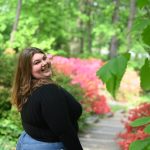 Michaela Godding is a loud and proud queer George Mason University Poetry MFA candidate. She works as an editorial coordinator for Poetry Daily and as a Poetry Alive! Fellow. Her debut chapbook, dwelling, was published by Bottlecap Press, and her first full collection, The Year Our Grandmothers Died, was just released through AOS Publishing. More of her work is featured in or forthcoming from Rabble Review, Same Faces Collective, the Connecticut Bards Poetry Review Book of 2022 (Local Gems Press), and the The Nutmeg Anthology (Grayson Books). When she’s not writing, singing, teaching, or reading poetry submissions, she’s most likely eating mac and cheese straight out of the pan. You can follow her current projects, interviews, podcast appearances and upcoming publications on her instagram, @michaelagodding.