Mama made a batch of blueberry pancakesthat day. I remember the doughstuck to every surface—Mama? What Mama. I had friends.I mean boys. There were three of us—five of us—two—one of them in particular.At that age one can be many.I owned a teal Schwinn, rusted—scooter with motorized carriage—I would ride even if the tires were flat.He knew every back alley and cut.The empty apartment two blocks over,its windows easy to open.Builders never finished the sash.Mama packed me a lunch of ham sandwich—egg salad and onion—peanut butter—potato chips between the bread.I remember thinking sashwas a nice sounding word—The first time I cameit felt like a window breaking.And I was the window.And I was the fist—I kept repeating that one word,silent, in my head. Sash.I might have muttered it once.It might have sounded like yes.It was sunny.I mean cloudy—I don’t remember the weather—It was always hot—Safe bet, it was hot.I might have said that once. It’s hot.You don’t understand context at that age.Context is everything. What the fuckdoes that even mean to a first grader—I didn’t cry about it. He once said tool.As in you don’t know how to use yourself.I do—I went to see Aladdin on Ice! with his parents—My parents took us to the movies—They chaperoned us in—They dropped us at the curb—We walked the same path to schooleach morning. Those back alleys, againWe learned about saturation in science class.How, eventually, a rag dipped in waterjust won’t hold any more.Is this too plain—Am I saying it clearly—What’s too much, too many—I’m afraid of the saturation point, my storylike a rag you can’t use to clean any damn thing.Hard, mostly, to admit it was another kid—Hard? Yes I was hard—I believed in the word stoic. Dead last in second-gradevocabulary but I clung to my few words—I was spelling bee champ. Mouth like a prize.He’d put it on my tongue and say spellmy name—My name, a question in Mama’s mouth:that’s how I knew she knew—Pops caught on first—I had two fathers. One, brand new. One,old, living off bourbon and canned tea.C’mere and rub my shoulder.How’d you get so good at that—Stoic—Sash—I lied about the fists. He never hit me—He hit me once—He slung coins at my ribs. He called mewishing well. I wished a lotuntil I learned what prayer was.I prayed for it to end—I prayed for it to keep going—Hard, mostly, to admit I was seven—they were ten—I’d just turned five—he was fifth grade, held back—I was nine when words becamethe empty apartment I live in today.It’s not like it fucked me up for life—We played a lot of Go Fish. I hid cardsup my sleeve. I liked to win. I think about thatsometimes. You know, winning. What that meantto me. Fish rhymed with wish. Go wish—Why would I come forward?It wasn’t like he was my teacher—parent—neighbor—He was my neighbor. He liked trivia.Do you know what sex means? I spelled it.I thought it meant somethinglike blueberry pancakes—I remember he windowed a girl. I meaninvited. I mean she never came over—She came over once—We went to her place—There was an attic, cold—That’s what I remember mostabout the basement. Wantingand not wanting. Not like it mattered.It was always hot. I’d get chills anyway.Goose pimples. I remember lying on the floor—couch—braided rug—looking at the rafters’ warped beamsand, between them, pinktufts of foam insulation that looked to melike flesh. New flesh. Impossibleto turn away from. Bulbous. Doughing.I mean bulging. You know,wet. Gleaming.Always there in the dark.Until I found myself reaching for it.Just to touch. To know. Surprisedto find it brittle, hollow,not at all warm—If I came, I didn’t have a word for it—We threw footballs on the street.Once, I cracked his windowinto pieces. That’s not a metaphor, exactly—The city was quaint—I hated the city. Big. Old.Nothing to do but rag rocks.I mean kick—It’s not like you could call it rape—He was a kid, I was a kid—I don’t believe in excuses—Pleasure. Now there was a wordwith coins in it. I learned to spell that onelater in life. Nickels and quartersfalling free. Mouth like a prize—The truth is I lovedthe ice rink—movie theater—sitting in the back row—dead last—I haven’t used the word body.How my body liked the thrill.I mean chill. I meanhow edges resolve in the darkuntil the curtain falls,the house lights come up—I mean, you know.
You Keep Asking the Question. We Keep Answering.
Feature Date
Series
- What Sparks Poetry
Selected By
Share This Poem
Print This Poem
Copyright © 2024 by Northwestern University.
Published 2024 by CurbstoneBooks/Northwestern University Press. Published 2010.
All rights reserved.
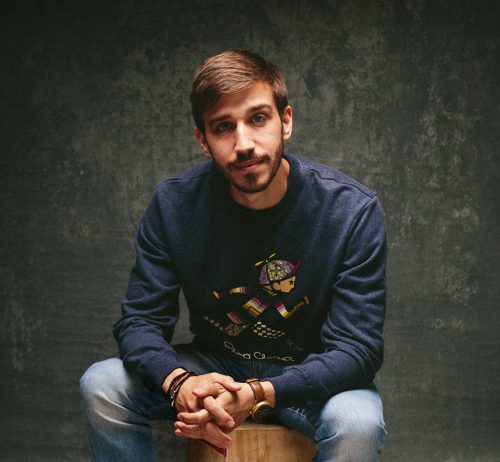
Perry Janes is the author of the poetry collection Find Me When You’re Ready (Curbstone Books, 2024). A Pushcart Prize recipient, his poems and stories have appeared in Ploughshares, POETRY, The Commuter, The Michigan Quarterly Review, Zyzzyva, Best New Poets 2024, and elsewhere. He earned his MFA in Poetry from Warren Wilson College and his BA from the University of Michigan, where he was a five-time recipient of The Hopwood Award. His debut novel is forthcoming from TriQuarterly in 2028. Originally from metro Detroit, he lives in California, where he works as a screenwriter.

Evanston, Illinois
Northwestern University
“In Perry Janes we have a powerful new voice in poetry. Now LA based, but coming out of metropolitan Detroit’s eclectic body of poets, Janes writes in all genres, but at long-last comes Find Me When You’re Ready, a stirring debut poetry collection divided into five acts. Janes displays, beneath the skill acquired over years of ‘doing the work,’ an unabashed earnestness that suggests an authentic need to say what cannot be easily told. As he notes, there are ‘so many / routes to the heart’s city.’ Janes writes as if through a prism—from several vantages. He compellingly repeats, insists, retracts, and iterates details of stories in an attempt not to get to the ‘what’ of an event, but the ‘who.’ To whom has this happened and who has this storyteller become? Janes is at the core a storyteller, and as any good storyteller knows, memory has its demands—Janes is determined to meet them. Read this bildungsroman and you will be inspired by Janes’s unsparing commitment to self-reclamation and hard-won joy.”
—Vievee Francis, author of The Shared World
“If a book could be your best friend, could be the dreamt of gentle avenger who gets you through the hardest nights of childhood. If a book could let you know life is so hard, but just wait, and you will find a world where even the pain you endured will find a way to blossom into deep health, into the deeply generative erotic. If a book could say: yes, the city is burning, the world is burning, some wounds never heal: but look at all your beloveds assembling. If a book could go back in time and teach me how to become an adult and carry my losses and make a world of extraordinary beauty that never says those losses didn’t happen? God, that book would be this book. Find Me When You’re Ready. I have been waiting my whole life.”
—Gabrielle Calvocoressi, author of Rocket Fantastic
Poetry Daily Depends on You
With your support, we make reading the best contemporary poetry a treasured daily experience. Consider a contribution today.